
news
Nine Years Under the Flag: A Navy Veteran Sees How the Australian Flag Is Made
Nov
“My name’s Kerrin Lovell. I joined the Navy in February 2006 and discharged in 2015.”
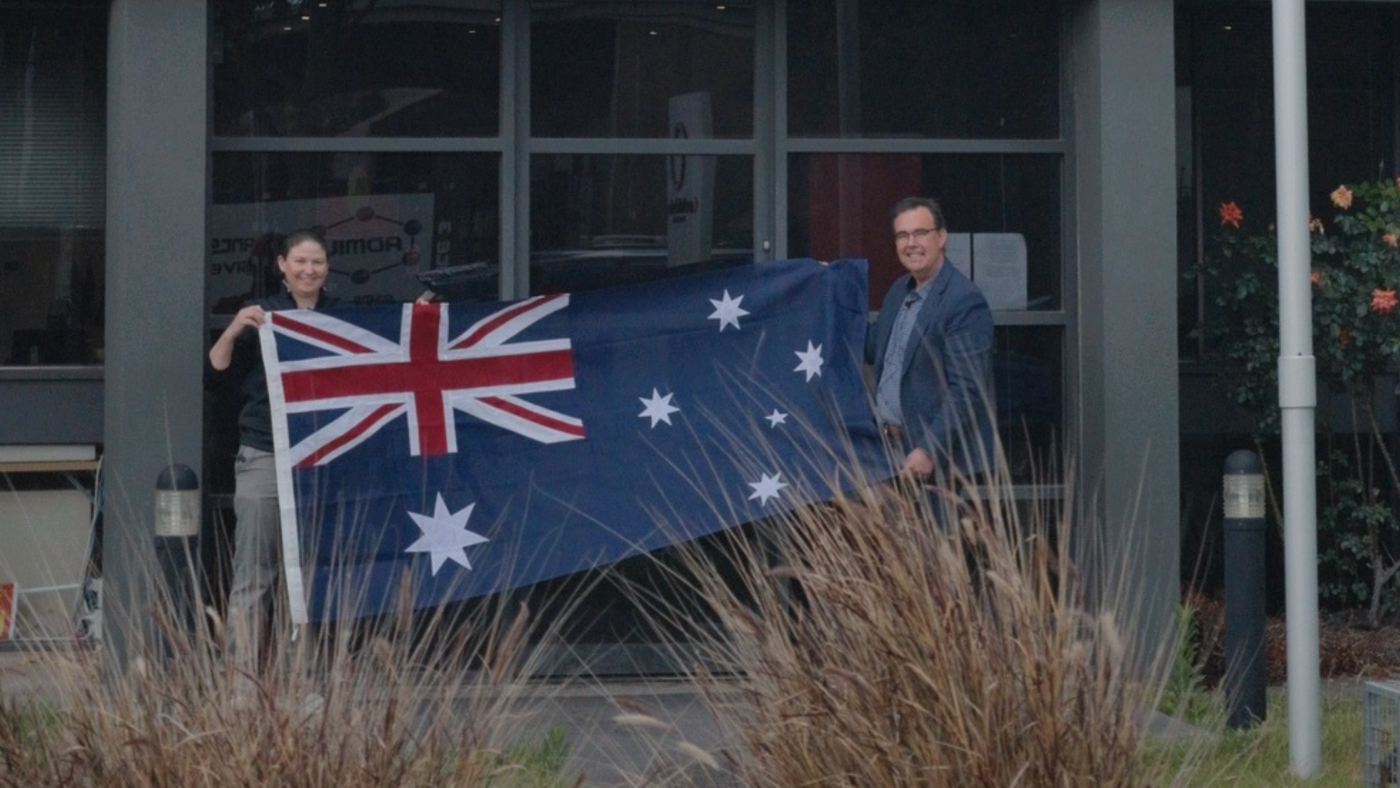
For nine years, Kerrin served under the flag. In honour of Remembrance Day, our CEO Rohan Sanderson invited her behind the scenes at our factory, where we’ve made flags since 1963, to see how the Australian flag is made.
Joining up to see the world
Before joining the Navy, Kerrin worked on a vineyard in Tasmania with her parents. The Navy offered something different. “I wanted adventure and just wanted to see the world, and to see every bit of it,” she says.
Five months after starting training, she was at sea on HMAS Kanimbla. Over the next nine years she sailed to ports around Australia and deployed overseas to the Middle East.
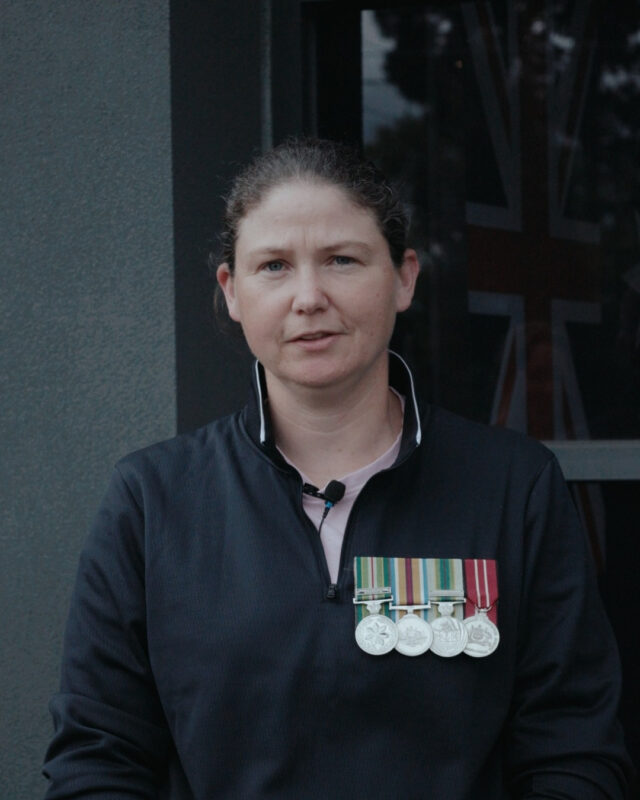
Life under the White Ensign
In the Navy, flags are part of everyday life. “When you’re at sea, you’ve always got an ensign flying on the mast,” Kerrin says. In port, the Australian National Flag flies at the bow of the ship and the White Ensign at the stern.
In the Royal Australian Navy (RAN), Colours takes place every morning at 0800 in harbour and at shore establishments. While a small duty party handles the flags, every sailor within earshot follows a strict sequence of actions. The Royal Navy formalised the ceremony in 1797, and Australian ships have flown their own White Ensign since 1967.
How Colours works
- Preparation (0755–0759). At 0755, duty personnel hoist the Preparative Pennant (“the Prep”) to the foremast and report “Five minutes to eight o’clock, Sir/Ma’am” to the Officer of the Day (OOD). At 0759, the Prep is shaken (or knocked against the halyard block) as a silent cue for the flag party to come to attention.
- The execution (0800). At exactly 0800, the Prep is dipped. Duty personnel salute and report “Eight o’clock, Sir/Ma’am!” to the OOD, who replies “Make it so!” The ship’s bell is struck eight times in four rapid pairs, and the Quartermaster or Boatswain’s Mate pipes “the Still”: a continuous, high-pitched eight-second note on a boatswain’s call.
- What every sailor does. The moment the Still sounds, all movement stops across the upper decks and base grounds. Sailors in the open stop, turn to face the Australian White Ensign and stand at attention. Officers, petty officers and warrant officers in uniform and wearing headdress salute, while junior sailors without headdress stand rigidly at attention. As everyone holds their salute, the duty party slowly and smoothly hoists the Australian White Ensign at the stern and the Australian National Flag at the bow.
- Dismissal. Once both flags reach the top of their staffs, the Prep is hauled down and the Boatswain’s Mate pipes “Carry On”. Sailors drop their salutes, vehicles move again, and the duty flag party is dismissed.
“Every time a sailor boards or disembarks from an Australian Navy ship, we salute the White Ensign,” Kerrin says. Sailors and visitors salute the Australian White Ensign, or the quarterdeck, when crossing the gangway, out of respect for the Sovereign and the authority of the warship. It’s a tradition that traces back to pre-Christian maritime shrines and Royal Navy protocols.
The ensign Kerrin flew during her 2012 deployment to the Middle East is now on display at the Anzac Memorial in Sydney. “It’s orange from one of the massive dust storms that we had.”
From hand wavers to Parliament House
The tour started in our warehouse, where thousands of flags are ready to go out: Australian, Aboriginal and Torres Strait Islander flags, the White Ensign, defence flags and flags of countries around the world.
They range from small hand wavers to the flag that flies above Parliament House. It’s 12.8 metres long, about the size of the side of a double-decker bus, and Rohan explained these are fully sewn by hand.
Kerrin had seen a flag on that scale before. On HMAS Kanimbla, whose hangar could hold three or four helicopters, a huge Australian flag would hang from the roof for special events.Printing the poppies
Printing the poppies
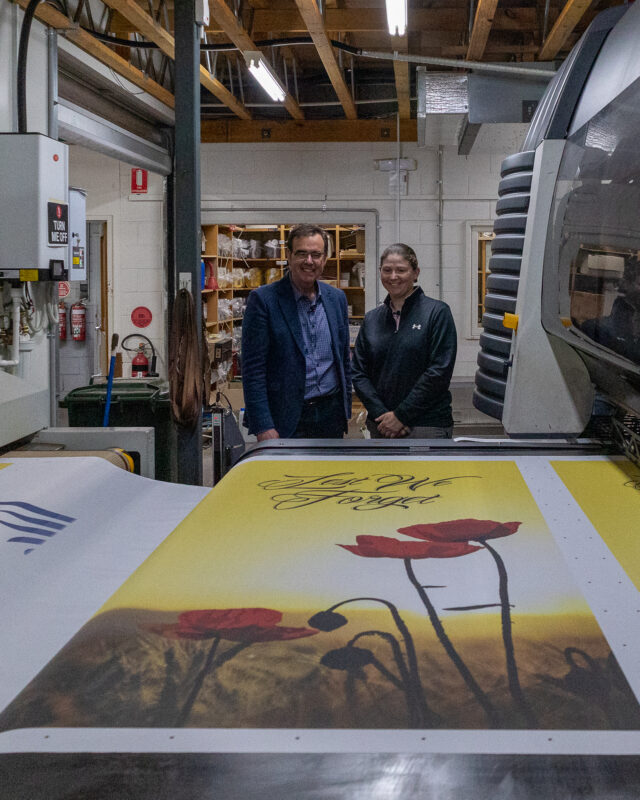
In our digital print area, Kerrin watched a Lest We Forget poppy flag come off the printer. 10% of sales from our Lest We Forget flags goes back to the RSL, supporting two separate appeals: the ANZAC Appeal and the Poppy Appeal.
It’s also where we print the Anzac Day and Remembrance Day street banners that councils hang along their main streets, each designed for its own community. “I always wondered who did those banners and where they came from,” Kerrin said.
How the Australian flag is screen printed
Our screen printer is the largest in the Southern Hemisphere and takes up a big part of our factory floor. It’s built for precision: each colour is printed separately, so the blue and red stay crisp and true, flag after flag. It’s a level of craftsmanship that’s hard to find, and it happens right here in Australia.
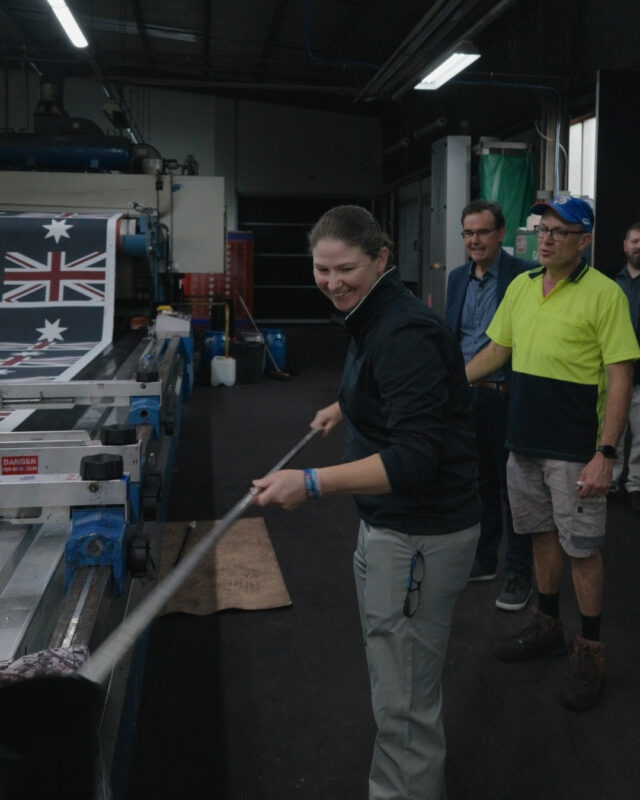
“I didn’t think it would be screen printed,” Kerrin said. Then she had a go herself, pulling the ink across the screen to print an Australian flag of her own.
From there, printed flags are set, washed, ironed, dried and cut with laser precision.
Sewn by hand
Upstairs, our sewers hem every flag so it lasts. They were busy with bunting for Australia Day, and repairing a Parliament House flag: the tattered end is cut off and a new piece hemmed on.
While most of our flags are printed, our premium flags are fully sewn, with every colour a separate piece of fabric. They’re the ones most often used for ceremonies. One Australian flag takes a day and a half to two days, made in sections: the Union Jacks first, then the body, then the stars.
Rohan presented Kerrin with a fully sewn Australian flag to take home.
Life after the Navy
Kerrin left the Navy in 2015. Since then, photography has taken her to Canada, Greenland and Iceland. “Photography gave me something to put my mind to,” she says.
It also connected her with other veterans through Veterans Instameet. “You don’t have to talk about your service history,” she says. “You just take photos.”
Through other veteran groups like Saltwater Veterans, she had the opportunity to sail the Sydney to Hobart yacht race in a crew of Australian veterans, racing a team of British veterans. “Being on the water, that’s my happy place.”
Remembering today’s veterans
Kerrin is matter-of-fact about her service. “I am proud of my service, but for me, I did a job. I was paid to do a job and I got the benefits of travelling.”
But she’s clear that days like Anzac Day and Remembrance Day still matter. With the veterans of the World Wars almost gone and Vietnam veterans growing older, she says it’s up to younger veterans, like her, to keep them going. “It should be important to everyone. It should still be commemorated.”
Thank you, Kerrin, for spending time with us and sharing your story.
- See Kerrin’s photography: @kerrin_lovell on Instagram
- Shop our Lest We Forget range
Frequently asked questions
How is the Australian flag made?
Australian flags are either printed or fully sewn. Printed flags are made by digital or screen printing, then set, washed, ironed and cut. Fully sewn flags are made from a separate piece of fabric for each colour.
How big is the flag on Parliament House?
It’s 12.8 metres long and 6.4 metres high, about the size of the side of a double-decker bus.
When did the Australian White Ensign come in?
On 1 March 1967. Before that, Australian warships flew Britain’s White Ensign.
